A decomposition preserves the problem; a good decomposition simplifies it. If the regions cover the feasible trajectory space X, the equality above holds. But an arbitrary partition can still leave difficult optimization problems inside its regions, or create so many regions that discrete search becomes expensive. A useful symbol exposes the choices that make the remaining solve easier.
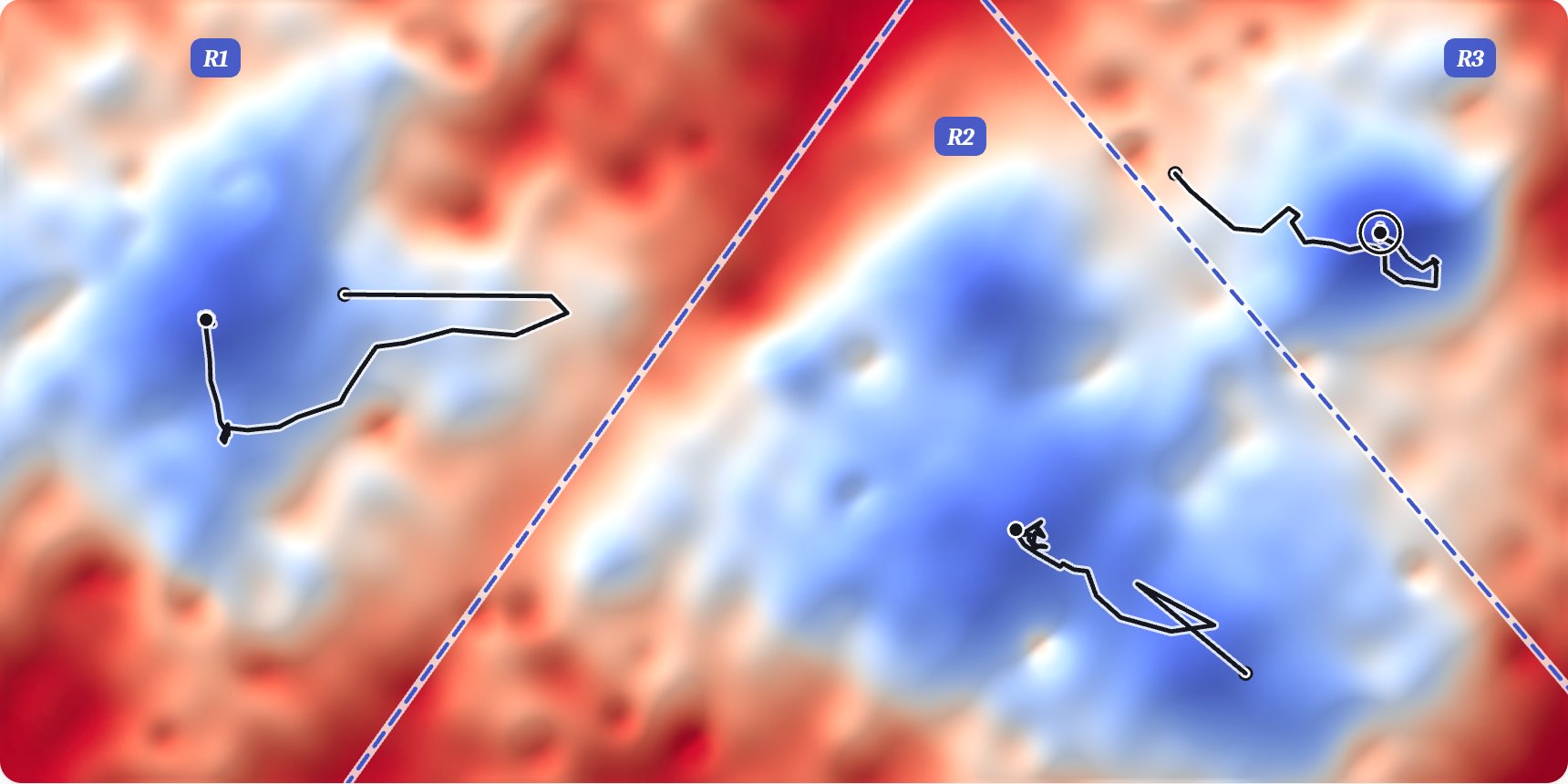
The landscape illustrates the difference. Each point represents a candidate trajectory, and its colour represents energy E(x). Without the partition, only 2 of 24 random restarts reach the lowest basin in this example. Two cuts divide the landscape into three regions; one confined descent per region finds three candidate solutions, and the best recovers the optimum.
We call this solver sufficiency. Symbols are useful relative to a solver: fixing their values should leave a subproblem that the solver can handle cheaply, while comparing the regional solutions preserves solution quality. We study this principle in piecewise-affine planning and learned neural energies, and invent symbols automatically by refining a partition when the solver reveals a failure.


